

Residual
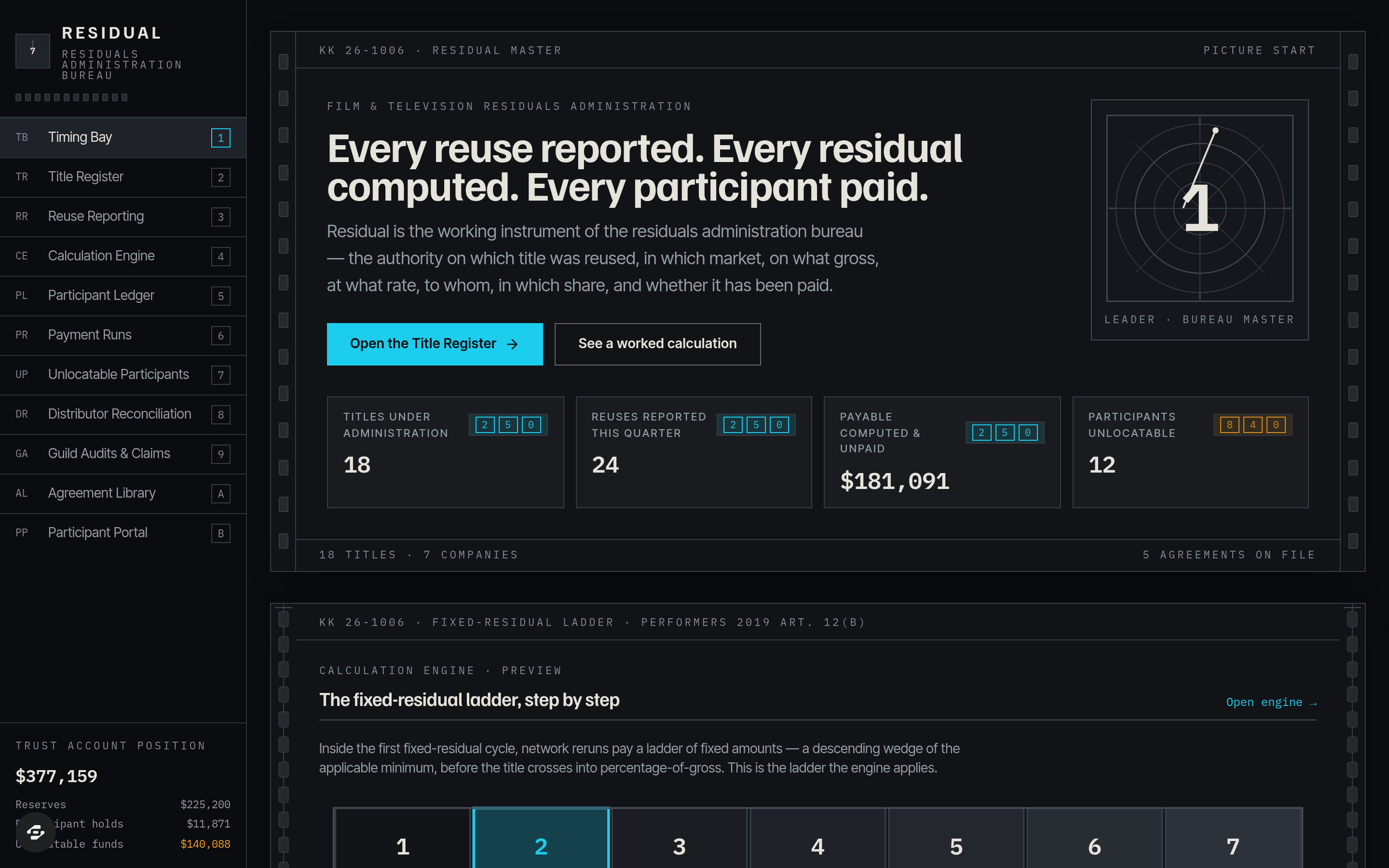
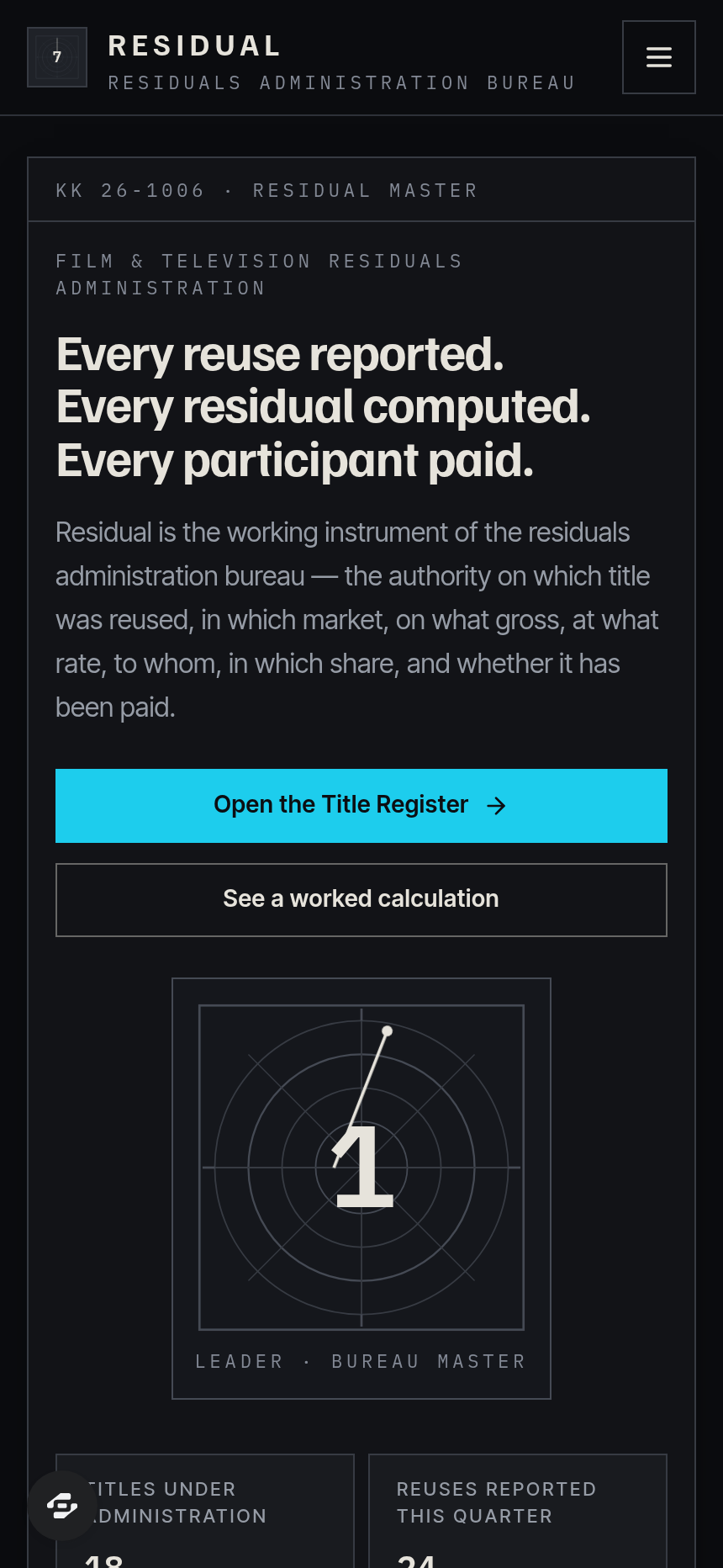
Residual is the complete reuse-reporting, residual-calculation and participant-payment record for a film and television residuals administration bureau.
About this template
Overview
Residual is the complete reuse-reporting, residual-calculation and participant-payment record for a film and television residuals administration bureau. It tracks which title was reused, in which market, on what gross, at what rate, to whom, in which share, and whether it has been paid—administering hundreds of titles for dozens of producing companies, computing what is owed to performers, writers and directors each time a picture is reused, and reconciling distributor gross receipts against collective agreements.
What you get
- Calculation Engine displaying applicable agreement and article, base used, deductions allowed, rate applied, pension and health contributions, and total payable as a worked calculation line by line, with fixed-residual ladder drawn as a discrete density step wedge
- Title Register holding each picture's production number, season and episode, type, producing company, current rights holder, agreements produced under, release dates, cumulative residual paid and reserve held, and audit flags
- Reuse Reporting listing every reuse event across free television, syndication, basic cable, pay television, home video, electronic sell-through, transactional rental, subscription streaming domestic and foreign, airline, ship and non-theatrical, with licensee, licence term, territory, language versions, exhibition count or subscriber figure, gross reported, and reporting gap in days
- Participant Ledger carrying every participant's guild and member number, role and credit, share basis, units held, amounts earned, paid and held, loan-out company payments, withholding applied, and lifetime total on that title
- Payment Runs with the period, titles included, item count, gross, deductions and withholdings, net disbursed, split between direct deposit, cheque and guild-collected, reconciliation to trust account, and rejected items with reasons
- Unlocatable Participants with last known address, amount held and duration, search steps taken from guild records through agent of record to estate representative to published search list, estate claims with documentation, and statutory holding period with escheat date and state
- Distributor Reconciliation setting reports received against reports due, gross reported against bureau expectation with variance stated, unreported markets identified, deductions claimed against agreement, queries raised with responses, and amounts recovered after query
- Guild Audits and Claims listing each audit's exceptions with amount claimed and basis, bureau's response as conceded or disputed with reasoning, settlement with date and amount, interest and penalties, and practice changes adopted
- Agreement Library holding each collective agreement's term and successor, rate tables by market and year, fixed-residual ladders with every step, definitions of gross receipts and permitted deductions, new-media and subscription formulas with subscriber-tier thresholds, and reporting and payment deadlines with late-payment interest rate
- Participant portal showing every title credited on, every reuse that generated a payment as the same worked calculation the bureau used, payments made with withholding, amounts held and why, and queries raised against a specific calculation and tracked
The signature screen
The Calculation Engine is the authority on which every residual payment is computed. For every reuse it sets out the applicable agreement and article, the base used—the applicable minimum salary, the fixed-residual ladder step, or the distributor's gross receipts—the deductions allowed before the percentage applies with each one named and quantified, the rate applied with the guild it belongs to, the run or step number where a ladder governs, the pension, health and welfare contribution computed on top at its own percentage, and the total payable. The calculation is written as a visible worked calculation line by line with every subtotal closing to the one beneath it, and the fixed-residual ladder itself is drawn as a discrete density step wedge with each patch carrying its step number and rate.
Who it's for
Residual is for the residuals administration bureau—the office that administers hundreds of titles for dozens of producing companies, computes what is owed to performers, writers and directors each time a picture is reused, reconciles distributor gross receipts, cuts tens of thousands of payment items a quarter, and answers guild audits when numbers are challenged. Participants also access their own portal to view every title they are credited on and every reuse that generated a payment.
Frequently asked questions
What is the Residual template?
Who is the Residual template for?
How long does it take to build an app with the Residual template?
Do I need to code to use the Residual template?
How much does the Residual template cost?
Can I customize the Residual template?
Review current pricing and the template inspection guide before you start.
Related templates
 Entertainment
Sonata
Audio that moves you
 Entertainment
Strike
Bowling alley lanes, parties & leagues
 Entertainment
Inkwell
Book your artist, browse the flash, heal it right.
 Entertainment
Deadair
No silence. No dead air. Station ops for volunteer FM.
Make this template your starting point.
Inspect the preview, plan your changes, and test the workflow before you share it.
Use this template