

Escheat
Escheat is the complete custody, determination and restitution record of a state treasurer's unclaimed property division — the office that takes custody of money nobody has claimed, holds it for the rightful owner, and pays it back only when that owner is proven.
About this template
Overview
Escheat is the complete custody, determination and restitution record of a state treasurer's unclaimed property division — the office that takes custody of money nobody has claimed, holds it for the rightful owner, and pays it back only when that owner is proven. It is the authority on what is owed, to whom, on what evidence, and what the state is holding.
What you get
- Property Register showing every property remitted by holder institutions, with state property ID, NAUPA property type code (AC01 checking, AC02 savings, IN01 life insurance, SD01 safe deposit, MS01 wages, SC01 dividends, UT01 utility deposits), owner name and address, amount held, dormancy period, report year, and status (HELD, CLAIM PENDING, PAID, ESCHEATED TO FUND, ADVERTISED)
- Holder reporting with each institution's FEIN, property count, aggregate remitted, filing timeliness against the November 1 deadline, and evidence of statutory due-diligence letters
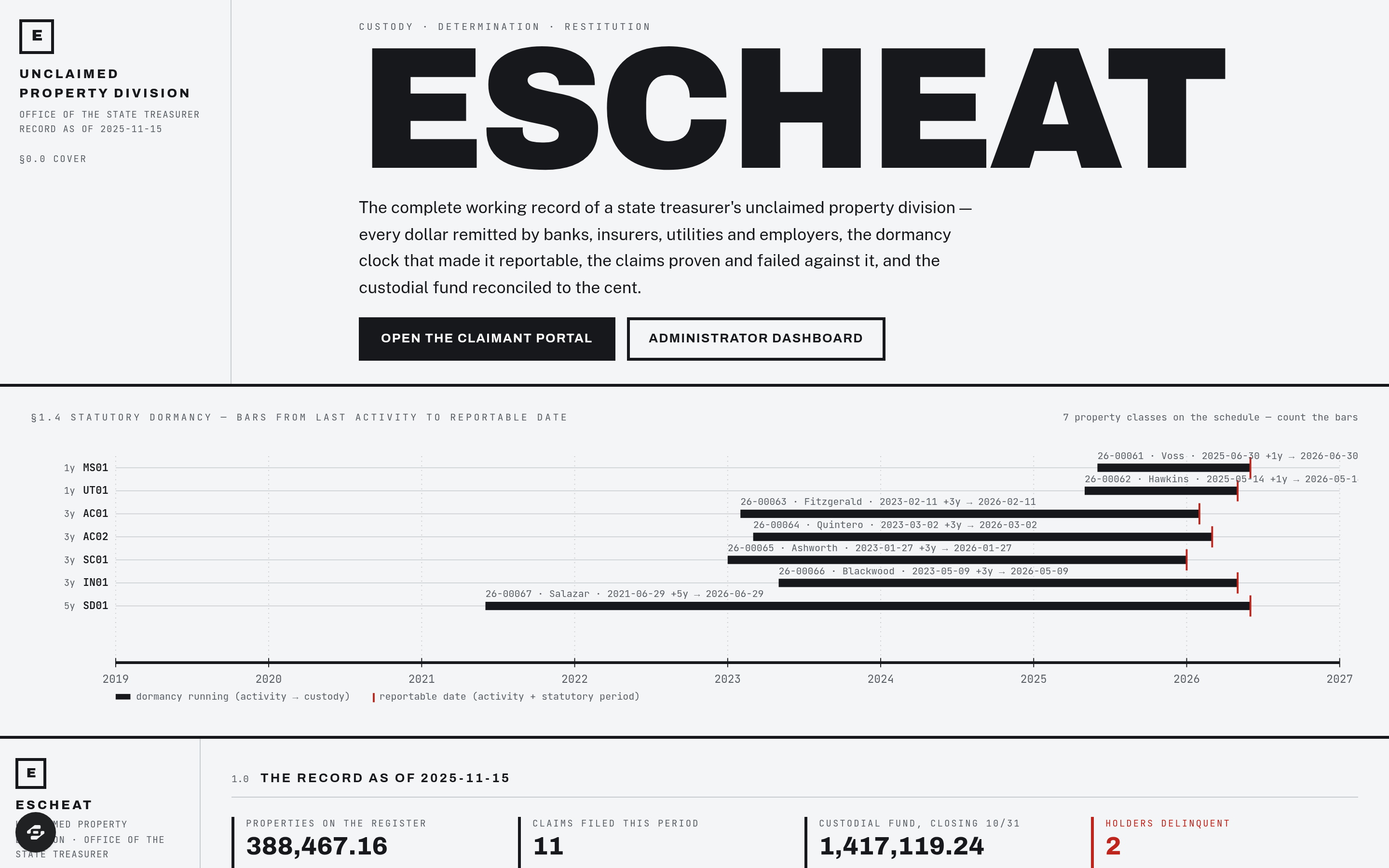
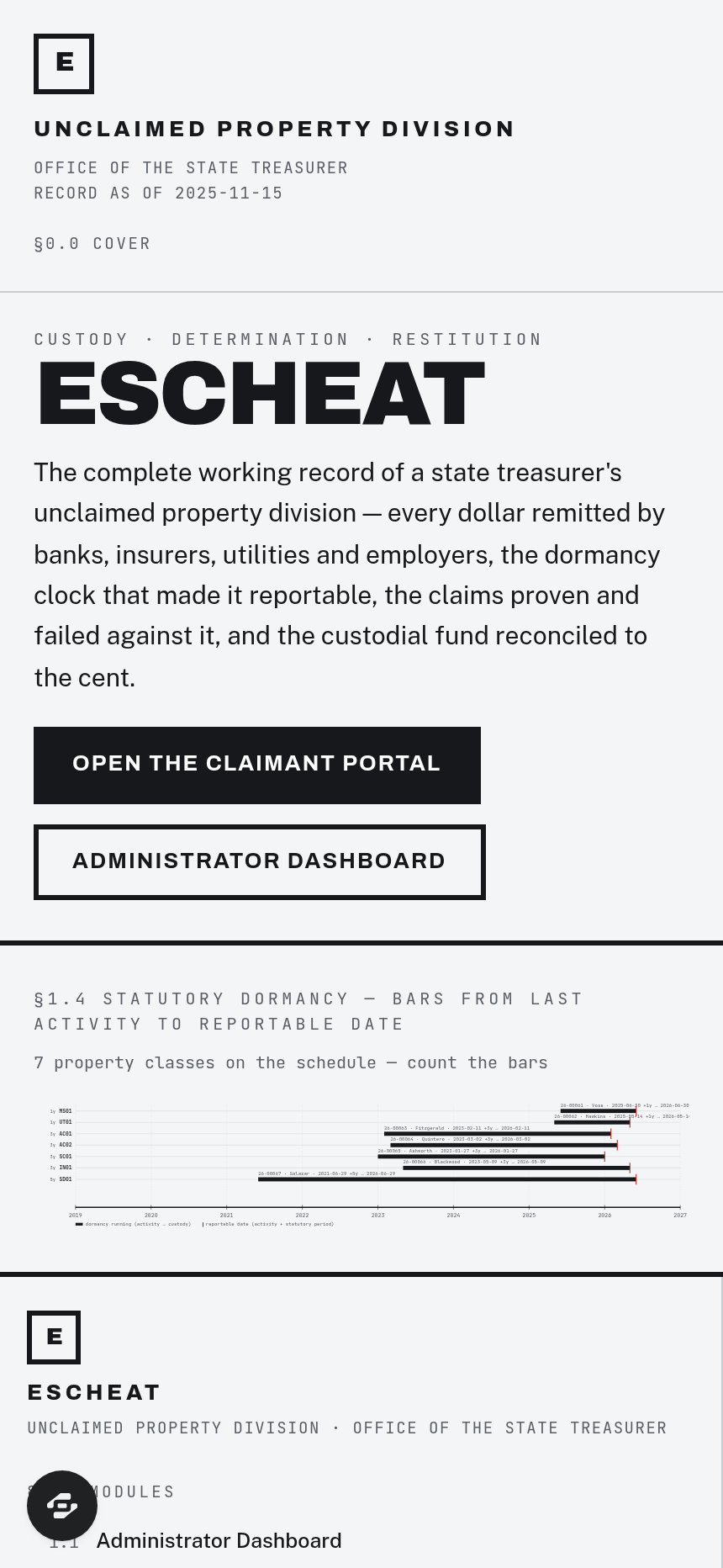
- Dormancy determination drawn against statutory periods (one year for wages and utility deposits, three years for bank accounts, insurance proceeds and securities, five years for safe deposit contents), with computed reportable dates and a nine-year timeline
- Claims examination with claim number, claimant, asserted relationship, evidence filed against evidence required, examiner assigned, days in examination against the ninety-day standard, and determinations (APPROVED, DENIED — IDENTITY NOT ESTABLISHED, DENIED — ENTITLEMENT NOT ESTABLISHED, RETURNED FOR DOCUMENTS)
- Intestate estates with heir search performed and kinship depth reached before residue escheated
- Safe deposit inventory with boxes drilled, contents enumerated line by line with appraised value, lot number, hammer price and cash proceeds
- Holder audits with periods examined, under-reporting found, interest and penalty assessed, and settlement reached
- Statutory advertising by county and publication date against the threshold that exempts smallest properties
- Remittance and reconciliation closing the custodial fund month by month as a waterfall (opening balance, remitted in, claims paid out, auction proceeds in, closing balance)
- Claimant portal that searches the public index, opens a claim, tracks stage by stage, and names exact documents outstanding
- Administrator dashboard showing properties held, aggregate custodial balance, claims against the ninety-day clock with the oldest named, and delinquent holders
The signature screen
The Property Register is the custody file itself: every property remitted by a holder bank, insurer, utility, payroll processor or transfer agent, carrying its state property ID, NAUPA property type code, owner name and last known address exactly as reported, the amount held to the cent, the dormancy period that applied, the report year, and the status reading. Behind it sits the nine-year dormancy timeline with a vermilion rule marking the moment custody attaches, and the claims examination instrument showing claim number, claimant, relationship asserted, evidence filed against evidence required, examiner assigned, days in examination against the ninety-day standard, and determinations that distinguish APPROVED from DENIED — IDENTITY NOT ESTABLISHED, DENIED — ENTITLEMENT NOT ESTABLISHED and RETURNED FOR DOCUMENTS.
Who it's for
Escheat is built for state treasurer offices and unclaimed property divisions that manage custody of unclaimed funds. It serves both administrators tracking holdings and claims, and claimants searching for and recovering property owed to them.
Frequently asked questions
What is the Escheat template?
Who is the Escheat template for?
How long does it take to build an app with the Escheat template?
Do I need to code to use the Escheat template?
How much does the Escheat template cost?
Can I customize the Escheat template?
Review current pricing and the template inspection guide before you start.
Related templates
 Finance
Ledger
Your books, beautifully kept.
 Finance
Rentroll
Every unit, rent, and repair in one place.
 Finance
Tallyroot
Every receipt, filed where it belongs.
 Finance
Carbon
Steady pay from lumpy freelance income.
Make this template your starting point.
Inspect the preview, plan your changes, and test the workflow before you share it.
Use this template